Jul 9 2010

Spice of Life Linoprints

It’s always exciting to get invitations to art gallery exhibition openings and this week I got one for an exhibition of lino-prints by Anna Curtis at ‘Framed ~ The Darwin Gallery’ that runs from the 9th July to the end of the month.

If you are lucky enough to be in Darwin (enjoying the beautiful dry season weather) I can highly recommend dropping into the Gallery to view this new body of work, which is described as ‘a feast of images that will lift your spirit and feed your soul’

Can’t wait for the new images of this exhibition to be put up on Anna’s  website, which will no doubt happen after she has had time to come up to breath… i.e. after opening night! :D

In the mean time, here is the link to a blog post I wrote last year about Anna that shows a few images of her work ~

And here are a couple more!

Which for now will have to suffice!


Jun 18 2010

Mangroves

‘Mangroves‘  vegetate the inter-tidal area between land and sea that gets flooded with the tides. The name Mangrove is therefore applied to any plant that is able to live in salt water whether a tree, a bush, a fern, grass or shrub.

Over 18% of the Australian coast line is vegetated with mangroves ~

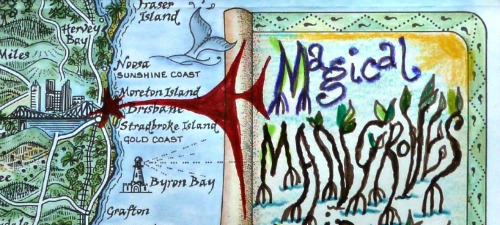
This week, I was sent an invitation to a gallery exhibition opening in Port Hedland with this beautiful pastel image on canvas of mangroves, by artist Sharon Jack.

Pastel on canvas by artist Sharon Jack

The exhibition of her work is to run through July to the end of August, should you be lucky enough to be in Western Australia during this period ~

The islands in the Bay off Brisbane, where I’m based, are surrounded by some beautiful species of mangrove ~

More than anything, I love their arched root systems

And these that must be years old with amazing gnarled and weathered trunks

As the soils in these zones have little oxygen the root systems are  generally close to the surface, and do a great job of helping to prevent erosion

:D

Journey Jottings:

Where/When/How ~ What did I See, Hear, Smell, Touch, Taste?

  • Australia’s inter-tidal zone
  • Arching roots
  • Clicking of crabs disappearing down holes
  • Un-oxygenated mud
  • Shiny leaves, slippery mud
  • Salt


May 7 2010

Snowdrops to Bluebells

When I arrived in Scotland mid March the Snowdrops were in full bloom in both cultivated gardens and wild woodland glades ~

Snowdrops in Scotland March 2010

Snowdrops

I was due to return to Australia 6 weeks later so the chances of seeing the first of the bluebells would possibly have been a little  optimistic ~

But then Eyjafjallajökull, the Icelandic volcano erupted!

Being grounded for just those few extra days meant I got to see some gorgeous spring wildflowers burst into life including violets…

Violet Violets :)

…in both violet and white!

White Violets

…Primroses and Lesser Celendine

…Forget-me-nots

…Yellow Archangel

and on those extra few days there at the end of April…

The first of the Bluebells

:D


Apr 26 2010

More flowers blossoming

Things are ever changing here in Scotland as spring advances -

We now have the wood anemones, primroses and may blossom just beginning to flower :)

Wood Anemones

Wood Anemones

Primroses

Primroses

May Blossom (Hawthorn)

The pussy willow has now exploded with pollen

Pussy Willow

And leaves on some trees are just starting to sprout!


Apr 23 2010

Trees

I love trees, and because in Australia most of our trees are evergreens (primarily Eucalyptus) I get a real thrill at seeing the deciduous trees of Britain in their winter skeletal form

And while this last tree is not deciduous…

it seems appropriate the final photo should be a Scots Pine :D


Apr 13 2010

Fungi, Moss and Lichen

Just before I left Australia in March I wrote a post about the autumn fungi I spotted on one of my last walks there ~ I associate fungi with the end of summer so was interested to see this tree fungi here in the Scottish spring!

Whilst most was hanging on the underside of the tree… there was some popping up on the top in between the moss!

There are over 700 species of moss in Great Britain, of which about 100 have been identified as occurring in the Wood of Cree, where this was photographed.

Whilst most occurs around the base of trees…

… including saplings…

it can also be seen growing on the branches ~

My attention was then taken by the most beautiful lichens, which are amazingly formed by a symbiotic relationship between fungi and algae.

Some look like coral from an underwater scene :)

It is said the presence of lichens reflects the purity of the air as with no roots their well-being is directly related to the atmosphere they are absorbing so they only grow where the air is free of pollutants.

Love the illustration below by Ernst Haeckel of lichens from his Kunstformen der Natur (Art Forms of Nature) book published in 1904

"Lichenes" from Ernst Haeckel's Artforms of Nature, 1904


Apr 2 2010

What is this flower called?

Just spotted this gorgeous little flower protected under the tree’d canopy on the woodland floor ~

They have a ‘splodgy’ variegated leaf

They only stand about 8 – 10cm tall

The flower reminds part of cowslip – part red campion!

The mix of coloured flowers on the one stem is simply beautiful

And to see them so early in the spring…

Anyone know what they’re called? :)

Many thanks to Kirsty Wilson and John Shortland who have left comments to this post having identified this flower as a Pulmonaria officinalis, which is from the Lungwort family :D


Mar 31 2010

Spring is Springing

This last winter in Scotland has been particularly hard, so the grass now looks yellowed and quite burnt by the snow and frost and the deciduous trees still stand silent in their bare hibernation.

After months of lifelessness it is such a treat to see signs of new growth when first the snow drops and crocuses push up through the hard cold earth ~

And we now have the catkins coming on…

and the Pussy Willow…

And the larch trees, which while a conifer are also deciduous so loose their spines in winter, are now just starting to show the feintest tinge of green as their fresh spines start to shoot.

(You have to look close to spot that one :) ! )

And the daffodils, a real ray of sunshine…

Daffodils and remains of the winter wood pile :D


Mar 8 2010

Autumn Fungi

Having just got back from the Trade Fair in Sydney I thought I’d post photos illustrating our booth when I got there – a bare black box – to when fully decked out with our red display stands, maps and the Journey Jottings banner flying over head…

However, in the process of taking a short-cut by importing and deleting off the camera all in one go, I managed to loose the lot :-(

After commiserating over a delicious hot buttery crumpet with blackberry jam :) I set off on the rebound for a evening walk with camera in hand and was treated to the most beautiful bevy of toadstools all popping up as we head into autumn ~

Now lets be honest ~ What would you rather look at? A trade fair, or these wonderful creations of nature? ;)

Autumn Toadstools

Toadstool

Beautiful Red Toadstool

Red Toadstools

Toadstool

Toadstool

Toadstool

Toadstool

Sand still perched on the top of this one having freshly popped its head up!

Toadstool

Toadstool

Toadstool

Toadstools

Toadstool

Is this a puffball pushing its way up?

Toadstool

This one looked like an anemone

Toadstool

Another puffball?

Toadstools

Toadstool

Red Toadstools

Red Toadstool

Toadstool

Toadstool

This one looks like a natural sponge!

Toadstools

What an amazing variety and in such sandy soil :)


Feb 12 2010

Banksia

After months of the local banksia trees showing only their old scruffy looking seed pods ~

Scruffy Banksia Seed Pods

Today, after a lot of rain, I noticed a couple of  beautiful fresh lemon yellow flowers blooming  :)

Banksia Flowers

The genus Banksia is named after the botanist, Sir Joseph Banks who accompanied James Cook on the 1768-1771 voyage to Australia.

Joseph Banks

He collected samples from Botany Bay which were sketched and painted by Sydney Parkinson a botanical artist who was also on the expedition.

I’ve always held a soft spot for banksia seed pods; they remind me of both muppets faces, and the beaks of baby birds gapping open wide begging for more worms!

Banksias were ‘brought to life’ by May Gibbs in 1918 in her children’s books Tales of Snugglepot and Cuddlepie.

Sadly for me they are portrayed as the baddies of the tale ~ Banksia Men :(

Banksia Man by May Gibbs