Jun 11 2010

Spiders

What am I doing walking along with a stick held aloft? :)

Water divining?

…  Water divining?

Nope ~ Just out for a leisurely evening stroll in the bush :D

But it’s spoilt when I walk into one of these!

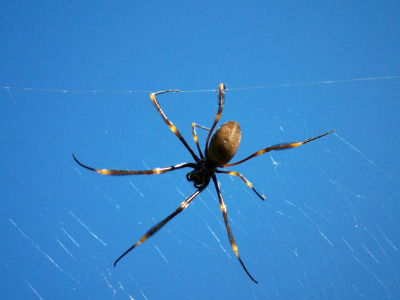
Spider across the path ;)

A spider draped across my path waiting for dinner to drop in!

I’m not quite sure what type they are :(  Do you know?

Spider waiting for dinner

They’re about 4 to 6 cm across

Spider's web between the trees

And they like to make their webs in the space across the path from bush to bush ~

Spider

When spotted in time, I’ll duck so as to leave the web unscathed and intact ~

Spider on his web

But there’s just nothing worse than having an unexpected face to face encounter! Hence the safety precaution of the stick ;)

These little chaps are a bit shier

Spider camouflaged as a leaf

Camouflaged in a curled up leaf they lay in wait in bushes along the sides of the track ~

Looking down into the curled up leaf

Obviously after smaller prey!

;)

Journey Jottings:

Where/When/How ~ What did I See, Hear, Smell, Touch, Taste?

  • Stradbroke Island, Q. Evening walk
  • long brown & yellow scampering spider legs, bulbous bodies
  • scrunching of dead leaves & twigs underfoot, snapping of surprisingly strong web strands across the path
  • honey myrtle & anticipation of an encounter
  • sticky pieces of web stuck in my hair & down my arms
  • natural Aussie bushland


Apr 23 2010

Trees

I love trees, and because in Australia most of our trees are evergreens (primarily Eucalyptus) I get a real thrill at seeing the deciduous trees of Britain in their winter skeletal form

And while this last tree is not deciduous…

it seems appropriate the final photo should be a Scots Pine :D


Apr 16 2010

Sculpture Treasure Hunt at Cairnsmore of Fleet Nature Reserve

Cairnsmore of Fleet is a National Nature Reserve covering just under 2,000 hectares of south-west Scotland.

Made up of wild and open heather moorland, Cairnsmore itself is a large granite ‘hill’ (2331 feet/711 metres) that rises unforested from river valley to summit; yet as one enters the Reserve it is the rugged  ’escarpment’ of the Clints of Dromore to one’s left that dominates the landscape.

The Reserve has a Visitor Centre where information regarding all the flora and fauna of the region is presented: visually – on large beautifully illustrated boards; kinaesthetically – with actual size jigsaws including one of a Golden Eagle that has a wingspan of more than 2 metres; and aurally – where with the press of a button sounds of the environment, such as the frogs and bird calls, can be heard.

I was lucky enough to meet Kevin Carter, the Reserve Manager, who enthusiastically inspired me to  search out not only the fabulous flora and fauna on the Reserve but also, to keep an eye out for the series of sculptures that artist Matt Baker had installed a couple of years ago, which accompanied poems by Mary Smith.

He gave me 5 cards showing photos of the installations, along with a clue for each on the back – But no hint of what order I might spy them, or how far off the track I may have to venture to find them :)

He also gave me a leaflet with a map called the Inbyre Walk ~ Can’t resist a map…

So off I set… and was thrilled when I found  ’Ocean‘ along the way.

'Ocean' by Matt Baker

But I was sorely dissapointed that that was the only one I found, not realizing I’d have to veer off the path to find the others :(

So, a few days later I returned for a second try!

It was the most beautiful day so following the clue …’over the stile, venture up where the ravens call and look down upon the inbyre’ I returned to the only stile on the walk and ventured off the beaten track up the rocky cliff face…

shared with the local inhabitants…

Looking back down to the Visitor Centre during the climb

And on the top of one of the cliffs this is what I found…

Hush

Poem by

Mary Smith

No one was here when lands crashed together,

no one to witness volcanic flames erupt

in fevered dance, nor see in hot lava tears,

this landscape’s beginnings.


When glaciers scoured rock faces,

carved mountains, opened rivers and lochs,

no one felt the icy touch

of their slow slide to the sea.


Except the wind, which still carries stories

of what once was, and how things came to be.


But the why of it lies deep

beneath its whisper,

in a silence with power

to unlock mysteries.


'Hush' and Linda Fairbairn with Cairnsmore Visitor Centre Inbyre in the distance

On the descent the viaduct, situated beyond the Visitor centre came into view ~ Built in 1860 (now no longer in use) it carried ammunition trains during the war.

And is famous as featuring in the 1935 film version of John Buchan’s novel ‘The 39 Steps’.

Once back down (across tuffty grass and mossy bog) I found ‘Heart‘ with the clue – ‘twixt viaduct and forestry, we lived here once’

'Heart' found in the remains of a stone building

and ‘Scene Shifters‘ with the clue ‘before the river is bridged, don’t get your feet wet!’

'Scene Shifters' by Matt Baker

With another 2 hour walk required for the final sculpture ‘Erratic‘…

that will have to wait for another day :)


Apr 9 2010

Water in the Wood of Cree

The Wood of Cree outside of Newton Stewart in south-west Scotland is a beautiful stand of deciduous trees protected by the RSPB for the local wildlife ~ While the Forestry Commission in Scotland plant Spruce for timber production, Spruce trees support only 37 species, where oak trees support 284!

Apart from the beautiful trees though there are some simply stunning waterfalls as the river twists, turns and cascades down over rocks and through gorges to join the River Cree at the bottom of the valley.


Apr 6 2010

Spring one day, back to winter the next!

Having just put up a post last week that Spring was Springing here in Scotland, a blizzard swept over the Highlands and the power was knocked out for 24 hours!

Woke up to flurries of snow in the air and with no electricity no immediate cup of tea… had to patiently wait for a kettle to boil over the fire!

However, seeing the snow on the mountains here in south-west Scotland was more than enough to make up for that little inconvenience :)

Craignell seen across Clatteringshaws Loch

Knockower seen from Carsphairn

The Glenkens, Carsphairn

Coran of Portmark, west of Carsphairn

The Merrick over Kirroughtree Forest

The Rhinns of Kells over Clatteringshaws Loch

Clatteringshaws Loch

Cairnsmore

Looking up the valley to Cairnsmore of Fleet

Cairnsmore of Fleet


Mar 8 2010

Autumn Fungi

Having just got back from the Trade Fair in Sydney I thought I’d post photos illustrating our booth when I got there – a bare black box – to when fully decked out with our red display stands, maps and the Journey Jottings banner flying over head…

However, in the process of taking a short-cut by importing and deleting off the camera all in one go, I managed to loose the lot :-(

After commiserating over a delicious hot buttery crumpet with blackberry jam :) I set off on the rebound for a evening walk with camera in hand and was treated to the most beautiful bevy of toadstools all popping up as we head into autumn ~

Now lets be honest ~ What would you rather look at? A trade fair, or these wonderful creations of nature? ;)

Autumn Toadstools

Toadstool

Beautiful Red Toadstool

Red Toadstools

Toadstool

Toadstool

Toadstool

Toadstool

Sand still perched on the top of this one having freshly popped its head up!

Toadstool

Toadstool

Toadstool

Toadstools

Toadstool

Is this a puffball pushing its way up?

Toadstool

This one looked like an anemone

Toadstool

Another puffball?

Toadstools

Toadstool

Red Toadstools

Red Toadstool

Toadstool

Toadstool

This one looks like a natural sponge!

Toadstools

What an amazing variety and in such sandy soil :)


Feb 20 2010

Dawn Chorus

There are times I wish I was more of an early bird!

Glorious sunrises…

… and the magnificent dawn chorus, which is so beautiful to hear :)

Our feathered friends put on such an enthusiastic fanfare as they pour their heart out singing in the day – I wish I got to hear it on a more regular basis! Such a variety of tunes, and it seems to be the only time of day I get to hear the butcher bird with his melodic aria – Not sure where he goes off to for the rest of the day.

Within an hour of the sun rising the ruckus has settled and the more pressing task – foraging for food - gets underway.

It’s then only the odd cackle of a kookaburra who breaks the silence to clarify who’s the owner of this patch ~

Kookaburra

This little group (there are three there!) frequently sit in the old gum tree outside my office window keeping an eagle eye out for unwelcome intruders; interspersed, of course, with diving off for the odd tasty morsel!


Feb 12 2010

Banksia

After months of the local banksia trees showing only their old scruffy looking seed pods ~

Scruffy Banksia Seed Pods

Today, after a lot of rain, I noticed a couple of  beautiful fresh lemon yellow flowers blooming  :)

Banksia Flowers

The genus Banksia is named after the botanist, Sir Joseph Banks who accompanied James Cook on the 1768-1771 voyage to Australia.

Joseph Banks

He collected samples from Botany Bay which were sketched and painted by Sydney Parkinson a botanical artist who was also on the expedition.

I’ve always held a soft spot for banksia seed pods; they remind me of both muppets faces, and the beaks of baby birds gapping open wide begging for more worms!

Banksias were ‘brought to life’ by May Gibbs in 1918 in her children’s books Tales of Snugglepot and Cuddlepie.

Sadly for me they are portrayed as the baddies of the tale ~ Banksia Men :(

Banksia Man by May Gibbs


Jan 15 2010

Christmas Beetles

Before the Christmas season is totally over, I want to share this photo I took on a walk over the festive season of this Christmas beetle -

They get their name due to their ‘sudden’ appearance at this time of year, but they look as though they have come dressed for the occasion wearing a green metallic waistcoat, which is  all of a sparkle and glittery!

Christmas Beetle

Christmas Beetle spotted on a Christmas walk

There are 34 species of the beetle genus Anoplognathus – The one above was about 35mm long.

The larvae is laid in the soil and takes either 12 or 24 months to mature (depending on warmth of winter) before pupating and emerging usually after the onset of the summer rains.

They are voracious eaters, making zigzag cuts into the eucalyptus leaves that they feed on, which shreds the leaves with much getting wasted as it falls to the ground. In numbers they can therefore have dire effects on eucalyptus woodlands. Happily, no such swarm was spotted here :-)


Sep 7 2009

Duck Billed Platypus

Platypus are such shy creatures it makes seeing one in the wild all the more remarkable and special!

When in northern NSW I’d go down to the creek with the children, in the early morning or late evening, and we’d stand on the wooden bridge scanning the water’s surface for a glimpse of the platypus we knew lived there. But the sightings could only ever be described as ‘fleeting’ as we’d turn our head towards movements caught out the corner of our eye only to catch the sight of bubbles, circled by ripples, as each time they’d elude our gaze as they ducked back down to the creek floor to forage for food.

Platypus by John Gould 1863

Platypus by John Gould 1863

It was not until I visited Eungella, 90km west of Mackay, Queensland that I got my first ‘real’ look at one in the wild.

There are viewing platforms set up along Broken Creek, where the platypus have become used enough to their admirer’s glances that whilst still shy, they can be seen more readily.

Only two monotremes exist in the world – The platypus and the echidna. Monotremes are egg laying mammals.

Another unique feature of the platypus is the venomous spur on the male’s hind foot, which when human inflicted causes great pain.

Australian 20 cent coin

The Platypus is featured on the Australian 20 cent coin

Seeing wild animals in their native habitat is simply magic ;-)